




Vitamin C has earned a permanent spot in many skincare routines, but buying a vitamin C serum can quickly get confusing. L-ascorbic acid, vitamin C derivatives, 10%, 15%, 20%, 30% — the labels can make the ingredient seem far more complicated than it needs to be.
The useful question is simpler: what can vitamin C actually do for your skin, and how do you know whether your serum is doing its job?
Topical vitamin C is mainly valued for its antioxidant, brightening, and collagen-supporting properties. It can help improve the appearance of uneven tone and pigmentation over time, while also helping the skin deal with oxidative stress caused by environmental exposure. Research supports these roles, although results depend heavily on the form of vitamin C, its formulation, concentration, stability, and how consistently you use it.
What vitamin C serum actually is: L-ascorbic acid vs. derivatives
Vitamin C is an umbrella term for several forms used in skincare. L-ascorbic acid is the pure, biologically active form that has been studied extensively in topical skincare. It is also the form with the biggest formulation challenge: it is sensitive to oxygen, light, and other conditions that can reduce its stability.
Vitamin C derivatives are modified forms designed to improve stability, formulation, or skin delivery. Examples include 3-O-Ethyl Ascorbic Acid, magnesium ascorbyl phosphate, sodium ascorbyl phosphate, and ascorbyl glucoside.
That difference matters when you're comparing serums. A 10% L-ascorbic acid serum and a 10% vitamin C derivative serum aren't necessarily equivalent products simply because the percentage on the label looks the same.
A review available through the National Centre for Biotechnology Information explains that L-ascorbic acid is effective but unstable, while different derivatives have been developed to improve stability and delivery.
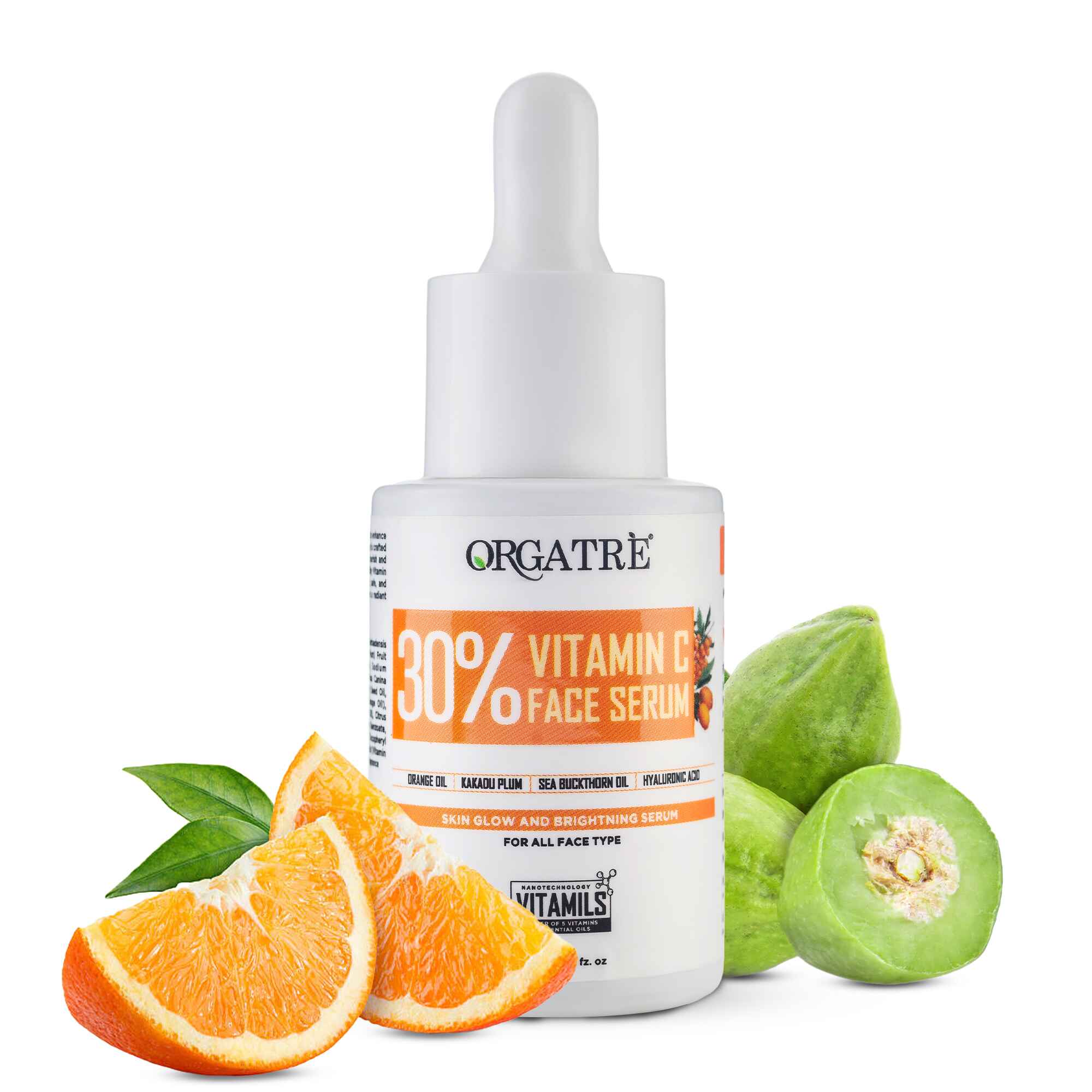
Orgatre's current Vitamin C Face Serum uses 3-O-Ethyl Ascorbic Acid and is marketed as a 30% Vitamin C serum, alongside ingredients such as niacinamide, glycerin, sodium hyaluronate, and vitamin E.
What it does: brightening, collagen support, and antioxidant protection
Vitamin C has three particularly useful roles in a skincare routine.
-
Brightening: Vitamin C can interfere with melanin production by affecting tyrosinase activity, which is one reason topical vitamin C is used in products designed for uneven tone and hyperpigmentation. It does not bleach the skin or change your natural skin color. Instead, consistent use may help make areas of excess pigmentation look less noticeable over time.
-
Collagen support: Vitamin C is involved in collagen synthesis, which is important for maintaining the skin's structure, firmness, and elasticity. Clinical research has found improvements in signs of photoaging with topical vitamin C formulations.
-
For example, a clinical study published on PubMed evaluated a topical antioxidant serum containing 15% L-ascorbic acid alongside other antioxidants and found improvements in skin-aging signs after 90 days of use.
-
Antioxidant protection: Everyday exposure to UV radiation and environmental pollutants can contribute to oxidative stress in the skin. Vitamin C acts as an antioxidant, helping neutralize reactive molecules involved in this process.
That does not make a vitamin C serum a substitute for sunscreen. Think of vitamin C as a supportive antioxidant step in your routine, while sunscreen remains the essential daytime protection.
The concentration that matters: 10–20%
When you're shopping for a vitamin C serum, a higher percentage isn't automatically a better choice.
For L-ascorbic acid, concentrations around 10–20% are commonly used in topical formulations. A PubMed study examining topical L-ascorbic acid found that skin penetration was optimized at 20%, while concentrations above that do not necessarily translate into better results.
Formulation matters just as much as the number on the bottle. L-ascorbic acid needs an appropriate acidic environment for effective skin penetration, but that same low-pH formulation can feel more irritating for some people.
Derivatives work differently, so their percentages shouldn't be compared directly with L-ascorbic acid.
This is also why you should read the ingredient list rather than judging a serum only by the headline percentage. Stability, packaging, supporting ingredients, and the specific vitamin C form all influence how the formula performs.
If you're comparing products while searching for the best vitamin C serum for face, look beyond the biggest percentage printed on the front of the bottle.
How long does vitamin C serum take to work?
Vitamin C is a consistency game rather than an overnight glow trick.
You may notice a fresher-looking complexion before you see a meaningful change in stubborn pigmentation, but deeper changes take longer. Clinical studies of topical vitamin C have assessed outcomes over periods ranging from several weeks to several months.
For example, a clinical study published on PubMed evaluated a 15% L-ascorbic acid serum over 90 days and reported improvements in skin-aging signs. Another randomized clinical study of topical vitamin C for photoaged skin followed participants for six months and found improvements in several measures of photodamaged skin.
Give your routine enough time to work before deciding that a serum has failed. Take photos in similar lighting every few weeks rather than relying on what you see in the mirror from one morning to the next.
If your main concern is dark spots or uneven tone, remember that sunscreen matters throughout the process. Continued UV exposure can keep contributing to pigmentation while you're trying to improve it.
How to layer vitamin C serum with SPF and niacinamide
A straightforward morning routine can look like this:
Cleanser → vitamin C serum → moisturizer → sunscreen
Apply your serum to clean, dry skin, allow it to settle, and follow with moisturizer if your skin needs it. Finish with broad-spectrum sunscreen.
Vitamin C and niacinamide can also sit comfortably within the same skincare routine. In fact, Orgatre's current Vitamin C Face Serum contains niacinamide alongside its vitamin C derivative.
If you're still getting familiar with vitamin C, our guide to Get Your Skin More Revitalized With the Vitamin C Face Serum covers the basics of incorporating a vitamin C serum into your routine.
If you're new to active ingredients, introduce one change at a time. That makes it much easier to identify what your skin tolerates and what causes irritation.
For readers looking for skincare guidance in Hindi, explore our Hindi skincare hub for more ingredient and routine advice.
Common vitamin C serum mistakes
A good serum can still underperform if the routine around it works against you.
Using the wrong order: Vitamin C serum usually goes after cleansing and before moisturizer. Applying several heavy products first can make the routine harder to layer and may affect how comfortably the serum sits on your skin.
-
Skipping sunscreen: Vitamin C supports antioxidant protection, but it does not replace sunscreen. If pigmentation is your main concern, daily sun protection is especially important.
-
Judging a serum after a few days: Skin tone and pigmentation changes take time. Give your routine several weeks of consistent use before assessing visible results.
-
Ignoring the formula: L-ascorbic acid is particularly sensitive to oxidation. Storage and packaging matter. A serum that has changed significantly in color, smell, or texture deserves a closer look before you continue using it.
-
Assuming more vitamin C means better results: A very high percentage can sound impressive, but concentration needs to be considered alongside the form of vitamin C, formulation, stability, and your skin's tolerance.
-
Layering too many actives at once: Adding vitamin C alongside several exfoliating or treatment products can make it harder to tell what your skin actually needs. Keep the routine manageable, especially when you're introducing a new serum.
So, is vitamin C serum worth adding to your routine?
If you're dealing with dullness, uneven tone, visible pigmentation, or early signs of photoaging, vitamin C is a useful ingredient to consider. Its strongest case comes from several complementary roles: antioxidant protection, support for collagen production, and effects on pigmentation pathways.
The important part is choosing a formula based on its form of vitamin C, concentration, stability, and your skin's tolerance, rather than choosing the biggest percentage on the label.
And if you're still comparing options, start with the ingredient list. The number on the bottle tells only part of the story.


